Garcinia cambogia vs green tea extract in Novuburn: which botanical wins?
Updated September 2026 · reviewed by the Novuburn Research Team. We are an independent information resource, not a medical provider, and this article is educational rather than medical advice.
Garcinia cambogia and green tea extract are two of the most common botanicals on a weight-support label, and they are constantly pitted against each other — but they are not really rivals. Garcinia supplies hydroxycitric acid (HCA), studied mostly for appetite; green tea supplies EGCG and caffeine, studied mostly for energy expenditure. (Onakpoya et al., J Obes 2011) This guide compares garcinia cambogia vs green tea extract honestly, weighs HCA vs EGCG, and explains why Novuburn uses both rather than crowning a single winner. The catechin itself gets a fuller treatment in our guide to green tea EGCG and fat burning.
Garcinia vs green tea, distilled.
- The honest verdict
- Neither “wins” alone; green tea has the stronger human evidence, while garcinia targets a different lever — appetite — so the two are complementary.
- Garcinia’s job
- HCA from the fruit rind is studied for appetite and how the body handles carbohydrates.
- Green tea’s job
- EGCG plus caffeine is studied for modest effects on energy expenditure and fat oxidation.
- Why Novuburn uses both
- Covering appetite and energy expenditure addresses more everyday obstacles than either botanical on its own.
Comparison articles love a knockout, but the botanical fat-support literature rarely delivers one. The more useful question is not “which is better?” but “what does each actually do, and do they add up?” Let us build the answer from the ground up, then look at how Novuburn puts the pair to work.
What is garcinia cambogia, and what is HCA?
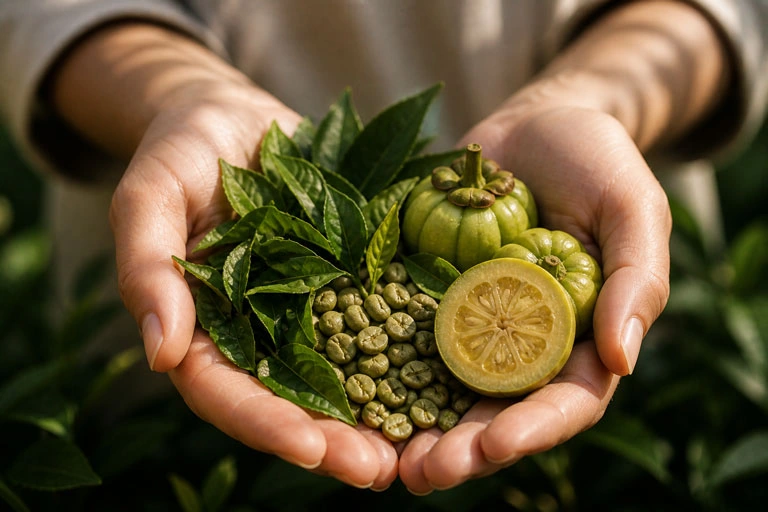
Garcinia cambogia is a small tropical fruit whose rind is the source of hydroxycitric acid (HCA), the compound behind almost every claim you have read about it. HCA is studied for two ideas in particular: a possible influence on appetite and a possible effect on how the body converts carbohydrates toward stored fat. In the lab, HCA can inhibit an enzyme called ATP-citrate lyase, which is a step in fat synthesis — but a mechanism in a cell is not the same as a meaningful result in a person.
How strong is the garcinia evidence?
Human trials on garcinia are generally small, short, and mixed. Some report a modest edge over placebo; others find no significant difference once diet is controlled. The most consistent thread people describe is a subjective sense of feeling less driven to snack. That is worth something in real life, but it is a long way from a guaranteed outcome, and honest reporting has to say so plainly.
What is green tea extract, and what is EGCG?
Green tea extract is a concentrated form of the compounds in brewed green tea, dominated by catechins — especially epigallocatechin gallate (EGCG) — alongside naturally occurring caffeine. Where garcinia is mostly about appetite, green tea is mostly about energy expenditure: the catechin-plus-caffeine pairing is studied for small increases in the calories the body burns and in the proportion of fat used for fuel, particularly during activity. (Dulloo et al., Am J Clin Nutr 1999)
Is the green tea evidence any better?
On balance, yes — the green tea catechin literature is larger and leans more favorable than garcinia’s, though the effects are still best described as modest, not dramatic. (Jurgens et al., Cochrane Database Syst Rev 2012) Reviews tend to find small average effects on energy expenditure and body weight that partly depend on caffeine and on the individual. It is a supportive nudge, not a switch. That caffeine content is also why timing matters, a point we return to below.

Garcinia vs green tea: how do the two botanicals compare?
Side by side, garcinia and green tea line up on different levers, which is exactly why a head-to-head “winner” is the wrong frame. Garcinia leans toward the intake side of the equation — appetite and carbohydrate handling — while green tea leans toward the output side — energy expenditure and fat oxidation. The table below summarizes the contrast in plain terms.
| Feature | Garcinia cambogia (HCA) | Green tea extract (EGCG) |
|---|---|---|
| Active compound | Hydroxycitric acid from the fruit rind | Catechins, chiefly EGCG, plus caffeine |
| Main studied angle | Appetite & carbohydrate handling | Energy expenditure & fat oxidation |
| Contains caffeine? | No | Yes, naturally |
| Human evidence | Smaller, shorter, mixed | Larger, leans modestly favorable |
| Honest expectation | Possible appetite support | Small energy-expenditure support |
See the exact garcinia & green tea dose in Novuburn →
HCA vs EGCG: what does the evidence actually say?
HCA and EGCG are studied for different mechanisms, and the quality of the proof differs too. HCA’s appetite story rests largely on smaller trials and self-reported hunger, so the signal is real for some people but far from universal. EGCG’s energy-expenditure story rests on a broader base of human research, much of it entangled with caffeine, showing small but repeatable effects. Neither compound belongs in the same sentence as words like “melt” or “guarantee.”
Where is the evidence weakest?
Both botanicals share the same honest caveats: many trials are short, doses and standardization vary between products, and results often shrink once diet and activity are properly controlled. Garcinia in particular has produced some headline studies that later failed to replicate. Anyone telling you either ingredient is a proven fat-burner is overstating what the science supports.

Why does Novuburn use both instead of picking one?
Novuburn combines garcinia and green tea because they cover complementary jobs, and a real routine has more than one obstacle. Cravings and afternoon energy dips are different problems; asking a single botanical to solve both is asking too much. By pairing HCA’s appetite angle with EGCG’s energy-expenditure angle inside a keto-support base, the formula spreads its bets rather than staking everything on one uncertain lever.
How does the combo fit the wider formula?
The garcinia green tea combo does not stand alone in Novuburn — it sits alongside a Tri-Salt BHB complex and powdered MCT that supply the ketone and electrolyte side of a low-carb routine. The botanicals are the amplifier, not the engine. If you want the mechanics of that fuel side, our BHB salts guide covers it, and the full ingredients section lists every component.
| Reasonable expectation | Not a claim we make |
|---|---|
| Appetite support from garcinia HCA for some people | Guaranteed or effortless weight loss |
| Small energy-expenditure support from green tea | A proven fat-burner or metabolism “boost” |
| Two complementary botanicals in one capsule | A replacement for diet and activity |
| Everyday support alongside a low-carb routine | A cure or treatment for any condition |
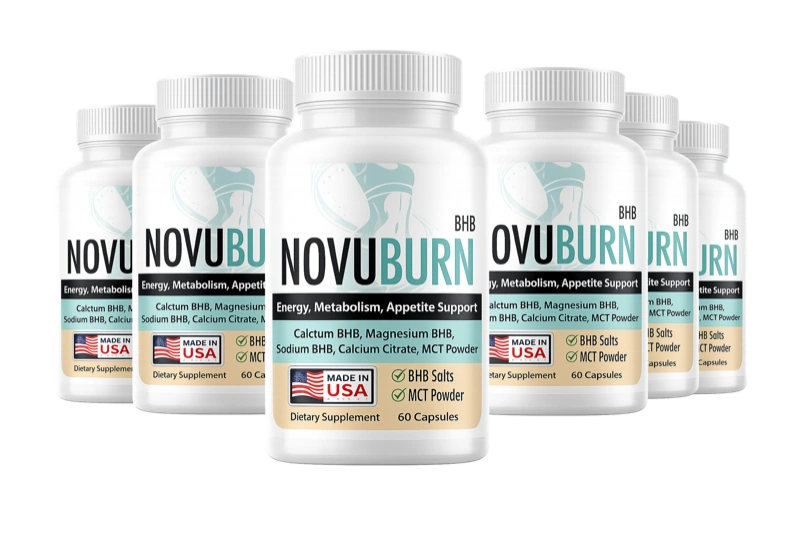
Garcinia and green tea, in one daily capsule
Novuburn pairs garcinia HCA and green tea EGCG with a Tri-Salt BHB complex and powdered MCT. The six-bottle bundle is the best value at $49 per bottle, with free U.S. shipping and a 60-day guarantee.
Check today’s Novuburn pricing — from $49/bottleHow do you use the garcinia green tea combo sensibly?
Because green tea extract carries caffeine and both are concentrated botanicals, a few simple habits keep the combo comfortable and realistic:
- Take it in the morning. Novuburn is a two-capsule morning serving with water, which keeps the green tea caffeine well away from bedtime.
- Start at the labeled serving rather than doubling up chasing a bigger effect.
- Pair it with a low-carb diet so the botanicals support a routine already moving in the right direction.
- Mind other caffeine from coffee or tea across the day if you are sensitive.
- Be consistent. Any modest botanical effect shows up over weeks of a daily habit, not in a single dose.
For more on the energy side of the formula, see how to beat keto flu naturally or the MCT oil vs powder guide.
When should you talk to a doctor?
Garcinia and green tea are generally well tolerated at labeled servings, but they are not right for everyone. Speak with a healthcare professional before using them if you are pregnant or nursing, under 18, take medication, or have a liver, heart or blood-pressure condition — the caffeine in green tea extract and rare reports around concentrated botanicals are reasons to check. Stop and seek advice if you notice any unexpected reaction.
Frequently asked questions
What is the difference between garcinia cambogia and green tea extract?
Garcinia cambogia is a fruit whose rind supplies hydroxycitric acid (HCA), a compound studied mostly for appetite and how the body handles carbohydrates. Green tea extract supplies catechins, chiefly EGCG, plus caffeine, and is studied mostly for energy expenditure and fat oxidation. They act on different parts of the picture, which is why they are often paired rather than chosen one over the other.
Is HCA or EGCG more effective for weight support?
Neither has strong, consistent proof of dramatic results on its own. Green tea catechins with caffeine have the larger and more favorable body of human research for modest effects on energy expenditure and fat oxidation, while garcinia HCA trials are smaller and more mixed. Both are best viewed as supportive, not decisive, and are studied alongside diet and activity.
Why does Novuburn combine garcinia and green tea instead of using one?
Novuburn uses both because they target complementary angles: garcinia HCA is associated with appetite and carbohydrate handling, while green tea EGCG and caffeine are associated with energy expenditure and fat oxidation. Combining them within a keto-support formula covers more of the everyday obstacles than either botanical alone.
Does the green tea extract in Novuburn contain caffeine?
Standardized green tea extracts naturally contain some caffeine, and caffeine is part of why green tea is studied for energy expenditure. If you are sensitive to caffeine or take it late in the day, factor that in, take Novuburn in the morning, and check the label and with your doctor if you have concerns.
Can you take garcinia and green tea together safely?
Many supplements combine the two, and they are generally well tolerated at labeled servings. Because green tea extract carries caffeine and both are concentrated botanicals, start at the labeled dose, do not double up, and speak with a healthcare professional first if you are pregnant, nursing, under 18, take medication, or have a liver, heart or blood-pressure condition.
Will garcinia and green tea make me lose weight on their own?
No. Neither botanical is a weight-loss shortcut, and the honest evidence points to modest, supportive effects at best. Diet, activity and consistency do the real work; garcinia and green tea in Novuburn are intended to support that routine, not replace it, and they are not a treatment for any condition.
Try Novuburn risk-free for 60 days →
Novuburn is a dietary supplement, not a treatment for any medical condition. These statements have not been evaluated by the Food and Drug Administration. This product is not intended to diagnose, treat, cure or prevent any disease. Always consult a qualified healthcare professional about your individual needs.
References & further reading
- National Center for Complementary and Integrative Health (NCCIH). Garcinia cambogia. nccih.nih.gov/health/garcinia-cambogia
- National Center for Complementary and Integrative Health (NCCIH). Green Tea. nccih.nih.gov/health/green-tea
- Onakpoya I, et al. The use of Garcinia extract (hydroxycitric acid) as a weight loss supplement: a systematic review and meta-analysis. J Obes, 2011. pubmed.ncbi.nlm.nih.gov/21197150
- Dulloo AG, et al. Efficacy of a green tea extract rich in catechin polyphenols and caffeine in increasing 24-h energy expenditure and fat oxidation in humans. Am J Clin Nutr, 1999. pubmed.ncbi.nlm.nih.gov/10584049
- Examine.com. Green Tea Catechins (EGCG) — evidence-based summary. examine.com/supplements/green-tea-catechins
- Examine.com. Garcinia cambogia (HCA) — evidence-based summary. examine.com/supplements/garcinia-cambogia
These references describe the ingredients in general terms and do not constitute evidence that any product treats, cures or prevents any condition.
Keep reading: BHB salts & exogenous ketones explained · how to beat keto flu naturally · back to the Novuburn blog · homepage.